
What Is Water Activity in Green Coffee?
What Is Water Activity in Green Coffee?
When evaluating green coffee quality, moisture content, bean density, physical defects, processing method, and sensory profile are usually among the first factors considered. However, moisture content alone does not fully explain how a coffee will behave during storage or how well it will preserve its quality over time.
This is where water activity, usually expressed as aw, becomes important.
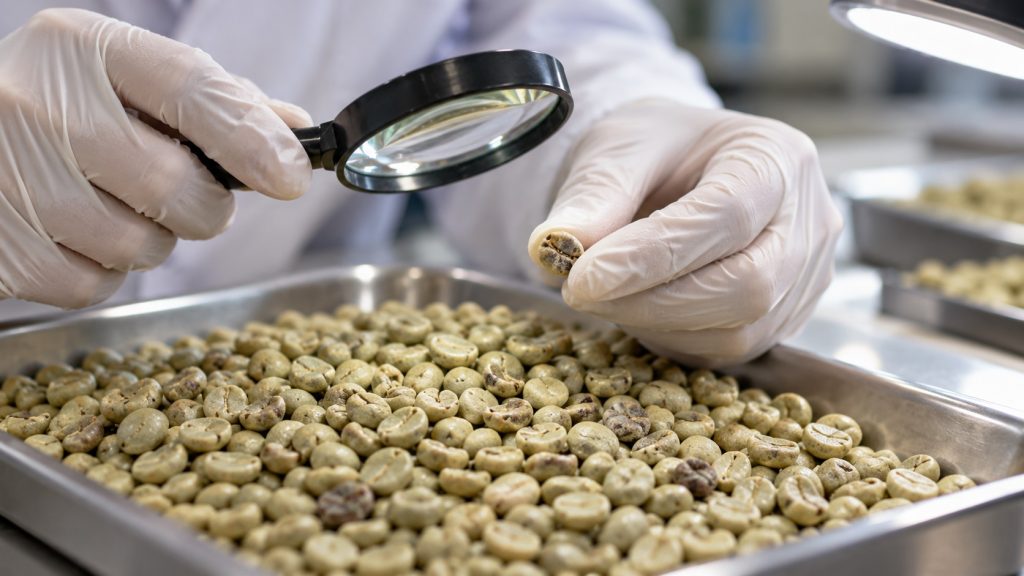
In green coffee, water activity does not measure how much total water is present in the bean. Instead, it indicates how much of that water is sufficiently mobile and available to participate in physical, chemical, and microbiological processes.
This makes water activity an important parameter in green coffee drying, storage, transportation, and pre-roast quality control.
In simple terms:
Moisture content tells us how much water is in the bean. Water activity tells us how active that water is.
The two measurements are related, but they are not the same.
In Short
Water activity in green coffee describes how available the water inside the bean is for physical, chemical, and microbiological processes. Moisture content measures the total amount of water, while water activity describes how that water behaves. This makes aw useful for evaluating storage stability, mould risk, ageing, and the physical condition of green coffee before roasting.
What Does Water Activity Actually Measure?
Water activity is usually expressed on a scale from 0 to 1.
A value closer to 1 indicates that water is more mobile and more available to interact with its surroundings. At lower values, a greater proportion of the water is more strongly bound within the structure of the product.
For green coffee, water activity can help assess:
- storage stability
- mould development risk
- microbiological activity
- ageing rate
- preservation of aromatic potential
- risk of reabsorbing moisture
- physical condition before roasting
For this reason, water activity is not merely a laboratory number. It can help describe how stable a green coffee lot may remain throughout the supply chain.
What Is the Difference Between Moisture Content and Water Activity?
One of the most common misunderstandings in green coffee quality control is treating moisture content and water activity as if they were interchangeable.
They are not.
| Parameter | What It Measures | Why It Matters |
| Moisture content | Total amount of water in the bean | Helps monitor drying and overall physical condition |
| Water activity | How active and available that water is | Helps assess storage stability and microbiological risk |
For example, two green coffee lots may both have a moisture content of around 11 percent.
Their water activity values may still be different.
This is because water can be bound differently within the cellular structure of the bean.
As a result, two coffees with similar moisture content may not behave in the same way during storage.
This is one of the main reasons water activity can provide useful additional information.
Why Is Moisture Important in Green Coffee?
Green coffee is an agricultural product that naturally contains water.
The goal is not to remove as much water as possible.
The bean needs a balanced level of moisture to maintain its physical integrity, colour, and roasting behaviour.
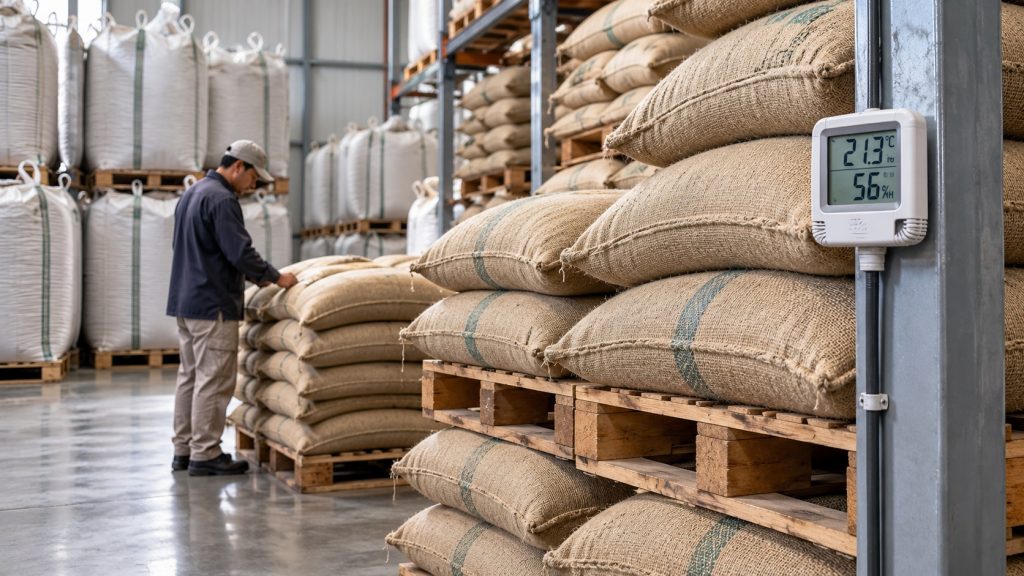
For many green coffees, a moisture content around 10.5 to 11.5 percent can be considered a practical working range.
Coffee that is too dry may:
- heat up more quickly during roasting
- become more brittle
- lose colour
- lose aromatic intensity more rapidly
Coffee with excessive moisture may:
- require more roasting energy
- heat more slowly
- become less stable during storage
- become more vulnerable to mould
However, moisture content still does not provide the full picture.
This is why water activity is useful as a complementary measurement.
How Does Water Activity Affect Green Coffee Quality?
Water activity is not a direct score of whether a coffee is good or bad.
Instead, it gives information about how stable the coffee is in its current condition.
High or unstable water activity can contribute to faster:
- microbiological development
- mould growth
- enzymatic changes
- oxidative reactions
- deterioration of aromatic compounds
- quality loss during storage
This is why producing high-quality green coffee is only part of the process.
That quality must also be preserved after drying.
A lot can begin with excellent physical and sensory characteristics and still lose quality over time if drying, packaging, or storage conditions are poorly managed.
What Is a Good Water Activity Range for Green Coffee?
There is no single ideal aw value that applies to every green coffee.
Interpretation depends on several factors, including:
- processing method
- moisture content
- bean density
- storage temperature
- packaging type
- relative humidity
- storage duration
In practical quality control, the goal is to keep water activity within a stable range where rapid quality loss and microbiological growth are unlikely.
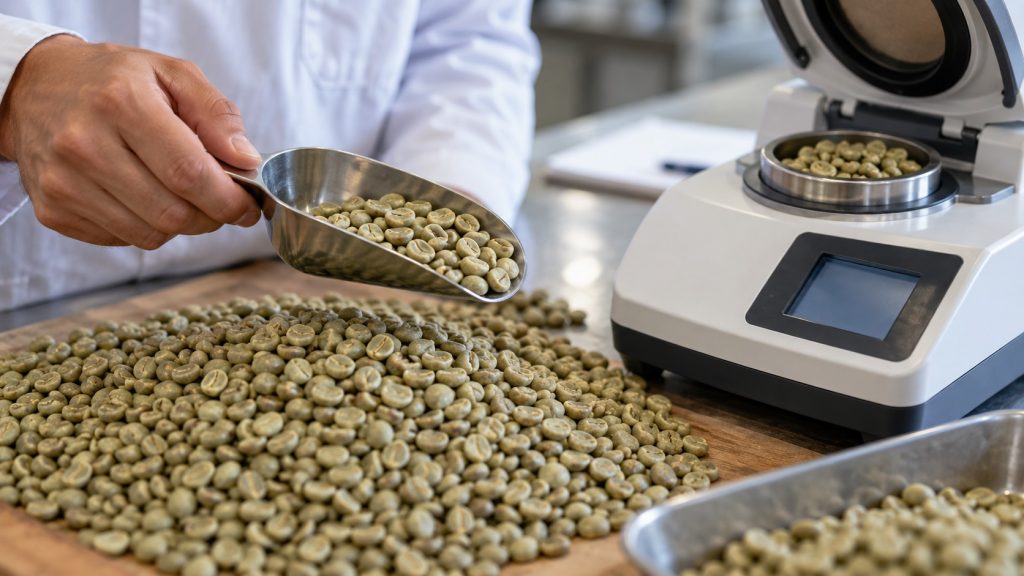
Values approaching 0.60 aw, or moving above that level, deserve closer attention, especially when coffee is stored in warm or humid conditions.
A single measurement is useful, but the trend over time can be even more valuable.
If the water activity of the same lot increases during storage, it may indicate changes in warehouse conditions or packaging performance.
Why Does Green Coffee Absorb Moisture from the Air?
Green coffee is hygroscopic.
This means it can exchange moisture with the surrounding air.
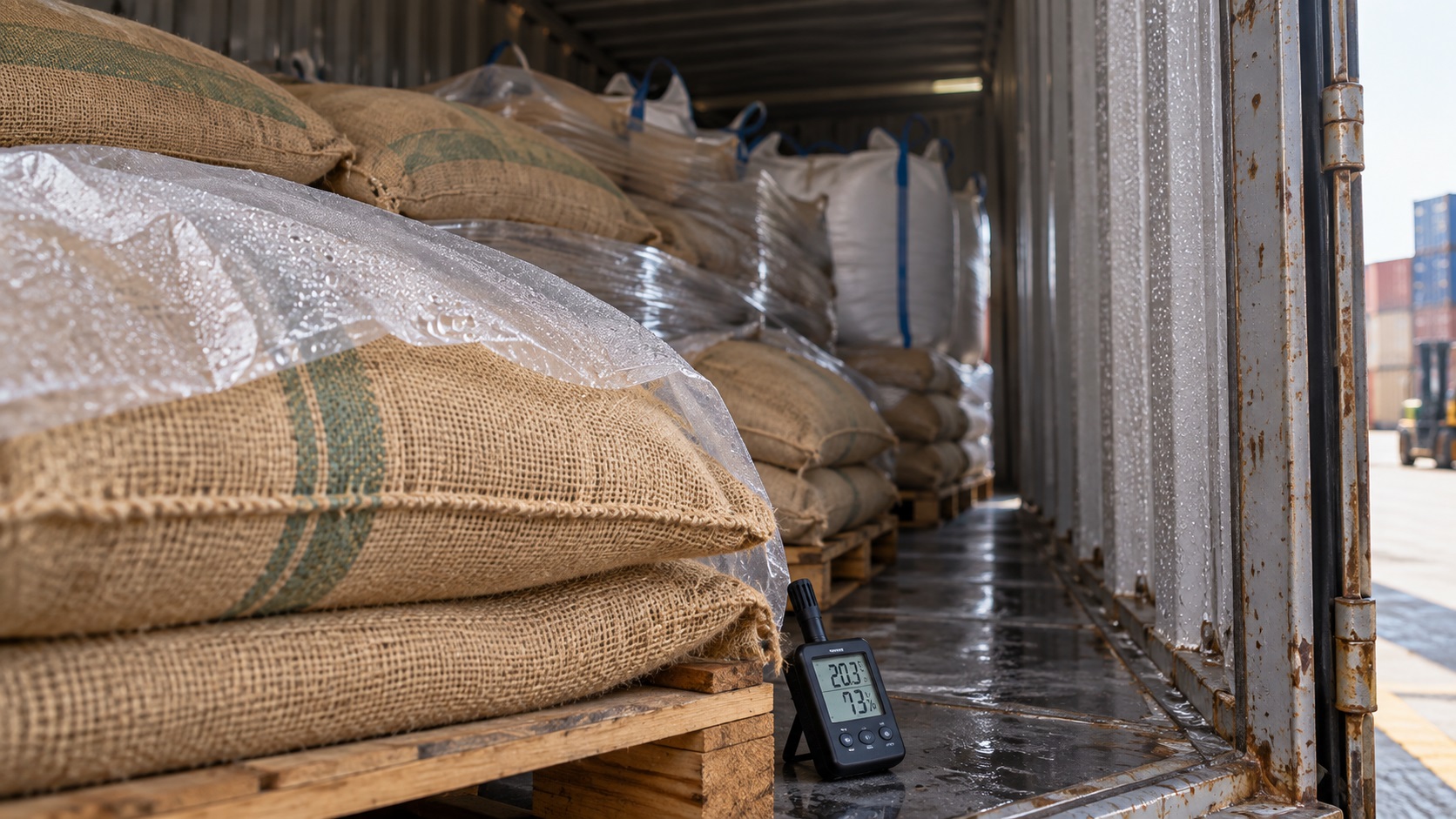
When relative humidity increases, green coffee can gradually absorb water.
When the environment becomes very dry, the bean can lose moisture.
This means the physical condition of coffee after several weeks or months of transport and storage may differ from its condition immediately after drying.
Important factors include:
- relative humidity
- temperature
- storage duration
- packaging
- transport conditions
Temperature changes are particularly important.
When coffee moves from a warm, humid environment into a colder one, condensation can become a concern. If the coffee already contains excessive moisture, the risk of rewetting and storage instability becomes greater.
How Is Water Activity Related to Mould?
One of the most important reasons for monitoring water activity is microbiological stability.
Microorganisms do not simply need water to be present.
They need water to be available.
As water activity increases, environmental conditions become more favourable for certain moulds and other microorganisms.
The risk becomes more significant when elevated water activity is combined with:
- high temperatures
- poor ventilation
- rewetting
- prolonged storage
For this reason, correct drying and stable storage conditions are essential.
Water activity can help identify potential instability before visible mould or obvious sensory defects appear.
How Does Drying Affect Water Activity?
Water activity management begins during drying, not after the coffee reaches storage.
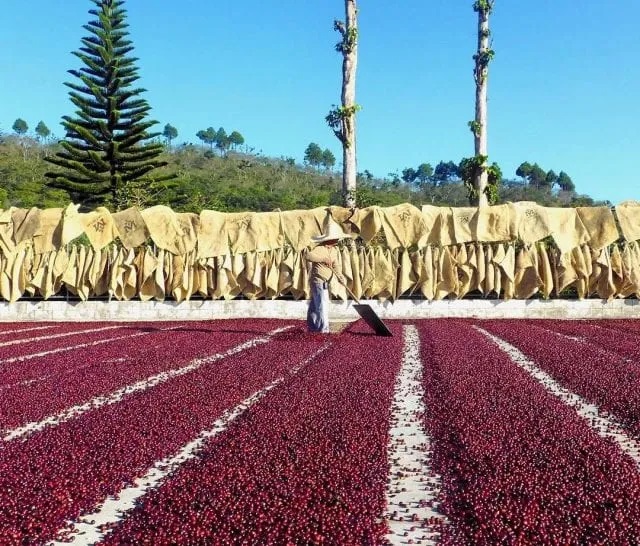
Fresh coffee fruit contains a high amount of water. During processing and drying, this water must be reduced gradually until the beans reach a stable condition suitable for storage.
However, faster drying is not always better.
If drying happens too quickly, the outside of the bean may appear dry while moisture inside the bean has not yet distributed evenly.
Good drying practice therefore requires control.
Important points include:
- turning the coffee regularly
- avoiding overly thick layers
- protecting coffee from rain and dew
- preventing rewetting
- increasing measurement frequency near the target moisture level
- allowing time for moisture to equalise after drying
Rewetting already dried coffee is especially undesirable.
It can contribute to colour changes, mould development, and unwanted cup characteristics.
Why Does Water Activity Change During Storage?
Green coffee is not a completely static material.
It continues interacting with its environment.
Several factors can change water activity over time.
Relative Humidity
In a humid warehouse, coffee may gradually absorb moisture from the surrounding air.
Temperature
Temperature changes influence moisture movement inside the bean and the amount of water vapour the surrounding air can hold.
Packaging
More permeable packaging allows environmental conditions to affect the coffee more strongly.
Barrier packaging can help reduce the exchange of moisture and air, making it easier to preserve green coffee in a stable condition.
Storage Time
Over longer storage periods, not only water balance but also lipids, aromatic precursors, and other compounds can change.
This is why water activity can be useful as a periodic quality-control measurement rather than a one-time receiving test.
Does Water Activity Affect Coffee Roasting?
Water activity is not a direct roasting parameter, but it provides useful information about the current physical condition of the green coffee.
During the early stages of roasting, a significant amount of energy is used to heat the bean and remove water.
Higher-moisture coffee generally requires more energy.
Very dry coffee may react to heat more quickly.
For this reason, green coffee moisture should be considered when developing a roast profile, and water activity can add context to that measurement.
A roaster may consider several factors together:
| Parameter | What It Tells the Roaster |
| Moisture content | Total amount of water in the bean |
| Water activity | How active that water is |
| Density | Physical compactness of the bean |
| Bean size | Potential heat-transfer uniformity |
| Processing method | Likely physical and sensory differences |
| Storage age | How the coffee may have changed over time |
None of these measurements provides a complete roast recipe on its own.
Professional roasting requires interpreting them together.
Is Lower Water Activity Always Better?
No.
The objective is not to reduce water activity as much as possible.
Over-dried green coffee can also lose quality.
When coffee becomes excessively dry, it may:
- become more brittle
- respond too quickly to heat
- lose aromatic intensity
- develop woody or straw-like characteristics
- age more rapidly
This is why drier does not automatically mean better.
The goal is a balanced and stable water condition.
When Should Water Activity Be Measured?
Water activity can be useful at several points in green coffee quality control.
Common measurement stages include:
- sample evaluation
- pre-purchase assessment
- before shipment
- receiving inspection
- long-term storage
- before roast-profile development
- whenever a storage issue is suspected
Comparing measurements over time is often more informative than relying on a single number.
If aw rises gradually in the same lot, packaging or warehouse conditions may need to be reviewed.
Why Is Water Activity Important When Buying Green Coffee?
Cupping remains one of the most important tools in green coffee evaluation.
But it is also useful to understand not only how good the coffee tastes today, but how well it is likely to preserve that quality.
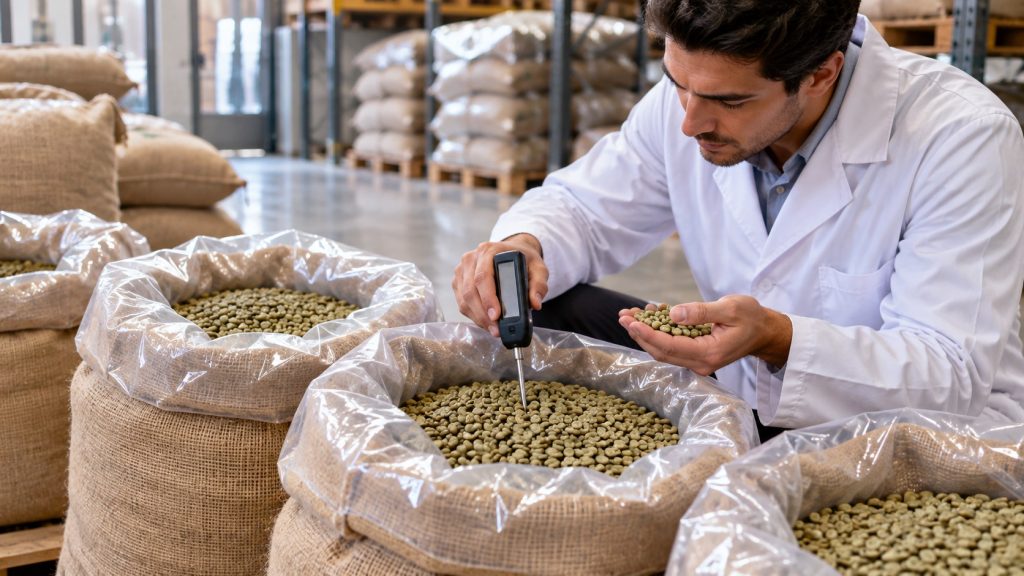
A more complete green coffee assessment can therefore consider:
sensory quality + physical quality + moisture content + water activity + storage conditions
This becomes especially important for lots that will be stored for several months.
A coffee can arrive with a clean, vibrant, and complex profile, yet change more quickly than expected if its water balance is unstable.
This is where water activity becomes particularly valuable.
It helps assess not only the coffee’s current condition, but also its stability over time.
Conclusion
Water activity in green coffee may sound like a narrow technical measurement, but in practice it is connected to almost every stage of quality preservation.
From drying and packaging to transportation, warehousing, and roasting, water inside the bean is constantly seeking equilibrium with its environment.
For this reason, evaluating green coffee only through moisture content can be incomplete.
Moisture content tells us:
how much water is in the bean.
Water activity helps explain:
how that water behaves.
The goal is not simply to achieve the lowest possible moisture or aw value.
The real objective is to maintain a balanced and stable water condition that protects the physical structure and sensory potential of the coffee.
When that balance is managed well, green coffee is more predictable during storage, more consistent for the roaster, and more likely to preserve the quality developed at origin all the way to the cup.
Frequently Asked Questions
1. What is water activity in green coffee?
Water activity describes how much of the water inside green coffee is sufficiently active and available to participate in physical, chemical, and microbiological processes.
2. Is water activity the same as moisture content?
No. Moisture content measures the total amount of water in the bean, while water activity describes how available and active that water is.
3. Why is water activity important in green coffee?
It helps assess storage stability, mould risk, ageing, and the overall physical condition of the green coffee.
4. What water activity level is considered safe for green coffee?
There is no single ideal number for every coffee. However, values approaching or exceeding 0.60 aw should be evaluated more carefully together with temperature, moisture content, and storage conditions.
5. What happens if water activity is too high?
Under favourable temperature and humidity conditions, higher water activity can increase the risk of microbiological activity, mould development, and faster quality loss.
6. Is lower water activity always better?
No. Excessively dry coffee can also lose quality, become brittle, and react too quickly to heat during roasting.
7. Does water activity affect coffee flavour?
Water activity is not a direct flavour measurement, but it influences storage stability. Over time, this can affect how well the sensory profile is preserved.
8. Does water activity affect roast profile development?
It does not determine the roast profile by itself. However, together with moisture, density, processing method, and storage age, it provides useful information about the current condition of the green coffee.
9. Why can green coffee reabsorb moisture?
Because green coffee is hygroscopic. It can absorb water from humid air and release water in a dry environment.
10. Should water activity be measured when buying green coffee?
For quality-focused lots, especially those intended for longer storage, it is a useful measurement. Combined with moisture content, physical analysis, and sensory evaluation, it provides a more complete view of green coffee stability.